



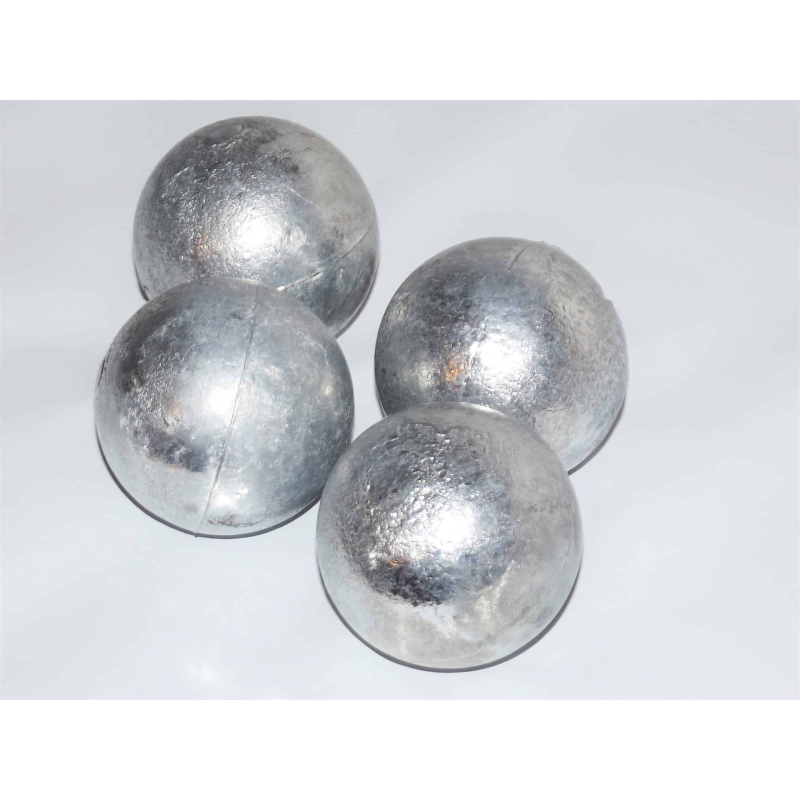
Zinc – brittle non-ferrous metal, plastically deformable between 100–150 °C, well forgeable and rollable, corrosion-resistant. Main use as corrosion protection (galvanizing), in brass alloys, and in industry, mechanical engineering, and electrical engineering. Available from Auremo.
Zinc is a heavy metal that is easy to work with, brittle, and bluish-white in color. Zinc belongs to the non-ferrous metals. Of all metals, zinc has the highest coefficient of thermal expansion. At normal temperatures, zinc is quite brittle. Between 100 and 150 °C, it can be deformed plastically. At temperatures above 200 °C, it burns into powder.
It can be well forged, rolled, and drawn into wire. Zinc is added to precious metal alloys to reduce the melting range and improve the melting range and castability. In brass alloys, it increases strength and changes the color of copper.
Zinc is used as an alloying metal in brass, tombac, nickel silver, or tin and aluminum alloys. When galvanizing iron and steel, it serves as a corrosion protection layer. This is done by hot-dip galvanizing or electro-galvanizing. As sheet metal, it is used to manufacture roofing, gutters, buckets, bathtubs, etc. Zinc is hardly attacked by pure water.
Properties of zinc:
Main applications of zinc
Online shop Auremo offers a wide range of rare earth metals. You can be sure that you will receive your goods. Our products always meet quality standards; all products are tested.
Mechanical properties (room temperature):
| Young’s modulus GPa | Bulk modulus GPa | Shear modulus GPa |
| 108 | 70 | 43 |
Physical properties (room temperature):
| Density g/cm3 | Melting point °C | Boiling point °C | Thermal conductivity W/m K | Electrical conductivity MS/m |
| 7.14 | 419 | 907 | 120 | 16.7 |
Zinc – brittle non-ferrous metal, plastically deformable between 100–150 °C, well forgeable and rollable, corrosion-resistant. Main use as corrosion protection (galvanizing), in brass alloys, and in industry, mechanical engineering, and electrical engineering. Available from Auremo.